Our goal in life should be - to be as good a person as our dog thinks we are.
Thank you for the siggy, Michelle!
Cindy (Human) - Taz (RB Tabby) - Zoee (RB Australian Shepherd) - Paizly (Dilute Tortie) - Taggart (Aussie Mix) - Jax (Brown & White Tabby), - Zeplyn (Cattle Dog Mix)
Thanks Cindy. I couldn't get the photo to attach for some reason.
Ask your vet about microchipping. ~ It could have saved Kuhio's life.
http://www.viralnova.com/terminally-...ampaign=aweber When 26 year old Chris Price found out he had terminal cancer and just six months to live, he decided that he would spend the rest of his days making the love of his life’s dreams come true.
It Looks Like The Most Picture Perfect Wedding Imaginable. Except One Devastating Truth.
February 20, 2014 Stories
He started out by proposing to 29 year old Ceri, and marrying her in a plush church with her four children as the guests of honor. It was truly a magical wedding.
Chris was sadly diagnosed with cancer of the oesophagus in April 2012.
Shortly after he was given the all clear, but tragically the cancer returned in April 2013 and he was told it was terminal.
With six months to live Chris promised himself he’d spend it making his girlfriend Ceri’s dreams come true, starting by proposing and then marrying her.
After the wedding, Chris took his new wife and her four children Halle, nine, and triplets Evan, Morgan and Georgia, six, to Disneyland Paris.
Few weeks after returning from Paris he whisked Ceri off to New York for a weekend of sightseeing and shopping. He splashed out on an expensive pair of Louboutin shoes and a $1,500 Mulberry handbag that she had always wanted.
The loving husband then booked a trip to Las Vegas for her birthday, but sadly he ran out of time… Chris died in Ceri’s arms last month and his funeral was held in the very same church where the pair had married just six months earlier.
After Chris passed away in January 2014 Ceri had this to say about her late husband:
If my love could have saved him, he would have lived forever. We packed so much into the short time we had together. His illness made him live completely in the moment and he taught me to do the same.He died in my arms and I felt his last breath. My heart is broken losing him and I still spray his Aramis aftershave and wear his clothes to feel close to him. He loved me and took me on with four children as if they were his own. They loved him so much too.
I have no regrets – we accepted what was going to happen and we savoured every single second we had together. At his funeral we played his favourite song Robin S – Show Me Love. That’s all he ever did was show everyone he met love. I miss him every moment of every day.Source: dailymail
They packed more love in the short time they had than most people have all their lives.
"Do or do not. There is no try." -- Yoda
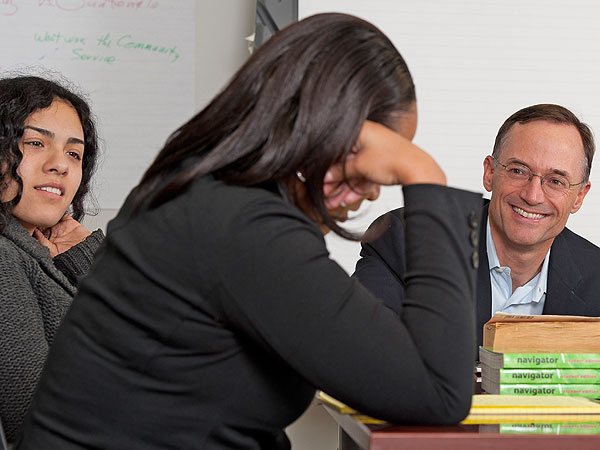
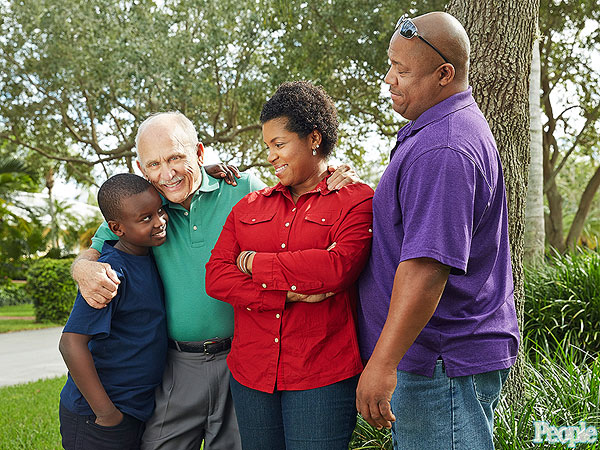
J.B. Schramm's Non-Profit Helps Kids Realize College Dreams
J.B. Schramm remembers the beat-up couches and broken TV in the teen center he started in 1990 in the basement of Washington, D.C.'s low-income Jubilee Housing project.
And he remembers LaToya, a high school senior in 1992 – a bright student who he thought had college potential. So the Yale and Harvard Divinity School grad, who had expected to be a teacher or minister, spent Saturdays helping LaToya complete an application and write a personal essay.
"When I saw her a few weeks later, I brightened up and asked, ‘So, did you get a bid?' " Schramm tells PEOPLE. "She said no. I said, 'Why not?' She said, 'I didn't have a stamp.' I thought she was joking."
From that one girl missing one stamp – what Schramm, now 50, kiddingly dubs "The Stamp Act" – a life-changing idea was born.
Today, Schramm's College Summit boot camps annually train 2,000 students who, in turn, work with 50,000 classmates in 175 high schools across 15 states. Those schools involved with College Summit see an average 20-percent increase in kids attending college, says Schramm.
"I realized that, for a lot of kids with talent but not a lot of resources, there was a systemic crater on the pathway to finding and getting enrolled in a college," he says.
He cites studies that find 95 percent of low-income eighth-graders say they want to go to college, but only nine percent will get a college degree.
"It's an outrageous loss of potential," he says.
Putting 'Cool Kids' to Work
Within three years of "The Stamp Act," Schramm had put together a four-day boot camp where 32 "cool kids" from six different states worked with writing coaches and college counselors on skills they would not only pour into their own college applications, but impart to their peers.
"It dawned on me one day when I put a tutoring sign-up sheet on the door of the teen center," he says. "After the coolest kid we had put his name on the list, we had 30 kids sign up, too. And I thought, 'What if we got the coolest kid to go to college?' If we could get young people taking charge and helping themselves, helping their friends, we could change the culture and make a lot of progress fast."
And College Summit is there for the rest of the kids, too, through its free apps – at CollegeAppMap.org – which, starting in 9th grade, take students through the 30 steps they need to take to get into college.
"For the first time, a lot of my low-income students are saying to themselves, college could be a possibility for me," says Doris Dabney, 49, a 16-year teaching veteran at D.C.'s Dunbar High. "College Summit empowers them to make choices."
From Little Haiti to Stanford
One of those empowered students was Emmanuel Fortune, who credits Schramm and College Summit with helping him carve a path out of Miami's Little Haiti.
"My mom was a single parent with a 3rd-grade education who worked 12-hour days and had 11 of us to care for," says Fortune, now 28. "So I didn't have someone looking over my shoulder and saying, 'How's that college application going?' "
That changed at College Summit.
"These guys would be like, 'Dad says I should apply to Brown.' And I was like, 'What is this color you're talking about?' " recalls Fortune.
Nudged along by College Summit, he enrolled at the University of Florida, earned a degree in English and later continued on to Stanford University and a Master's in education policy.
Today, he is a married father of one and a consultant at Deloitte in McLean, Va.
And LaToya, the girl without the stamp, eventually made it too – to the University of the District of Columbia and a career in early childhood education, says Schramm.
"For me back then, it was, 'How do I get out of this and do more for myself?' College Summit connected me to this wider world," says Fortune. "J.B. built that bridge. He's truly a rock star."
![]()
Ask your vet about microchipping. ~ It could have saved Kuhio's life.
Honest Cape May Waitress Returns Lost Cash To Customer, Refuses Reward
CAPE MAY, N.J., (CBS) — A Collingswood man is walking around with renewed faith in the goodness of people — after being reunited with a big wad of cash that he dropped in Cape May.
CBS 3′s Cleve Bryan has more on the lost and found, and a restaurant worker who did the right thing.
Paul Hendry will tell you this isn’t just any motorcycle, it’s a Honda Goldwing 50th Anniversary model.
“Saved for a long time because we were beginning a long trip,” he said.
That dream of riding along a scenic highway was almost parked before ever got in gear. The night he took out the cash to buy it he and his wife went to The Ugly Mug in Cape May for dinner. And when they went to go buy the bike later, the money was missing.
“I had my leather jacket on and I’m going, I don’t have it. My wife said you’re kidding me. I said no Carol. I’m shaking, I’m real nervous,” he said.
They figured the cash must have fell out at The Ugly Mug.
“So I called up and Diana Lee answered the phone,” he said.
Waitress and hostess Diana Lee grabbed her phone and used it as a flashlight to look under the booths.
“I told them can you please lift your feet up, they were kind of laughing at me,” she said.
Lee says it was a fairly busy Saturday night but when she got to this booth, sure enough there was the money on the floor.
“It was a wad of cash about the size of a salt and pepper shaker,” she said.
Sixty-five hundred dollars — all in $100 bills.
“Everybody was like astounded like how much is this,” she said.
Lee could have easily pocketed the money and used to pay for a semester of college – but she didn’t.
Hendry got the money, then the bike. Lee wouldn’t even accept a reward.
“My parents worked for 30 years with their own business from the bottom up and I know what that’s like to see someone finally get their little piece of paradise,” she said.
“I’ll work for it just like everyone else, karma hopefully will be on my side someday,” she said.
And hopefully some generous tips.
Ask your vet about microchipping. ~ It could have saved Kuhio's life.
When a baby stops breathing, Florida motorists pitch in to help
Pamela Rauseo was stuck in traffic on a Miami highway Thursday when her 5-month-old nephew, strapped into his car seat behind her, stopped screaming -- and she knew something was very wrong.
"That was a red flag for me, because the car was at a standstill, and he'd had a little bit of a cold, and I knew that he was congested, so I got really worried," Rauseo said Friday of her nephew, Sebastian de la Cruz.
She had good reason to worry as she stopped along State Road 836, a six-lane stretch of concrete known locally as the Dolphin Expressway.
"I pulled over on the left, and I jumped to the back to check up on him, and he was out. He was sleeping, and I touched him to stimulate him. I got no response, so I took him out of his car seat, and he was completely limp and turning purple. I tried to call 911, but I was just so nervous, my hands wouldn't function."
Rauseo screamed for help, and fellow motorists responded.
Lucila Godoy was among the first.
"I was driving in the middle lane; she was in the fast lane, and all of a sudden I see her, and she's screaming and she's holding the baby and she's putting it up and down," Godoy said. "I just stopped the car and jumped out of the car, and I asked her what was going on, and we started working as a team."
Godoy had taken a CPR course when she was pregnant in Venezuela with her own son, also named Sebastian. "I didn't even think about it," she said. "I just hold the baby like my baby. ... When I heard her screaming 'Sebastian,' that was hard."
Soon, Sweetwater Police officer Amauris Bastidas stopped and helped the women perform chest compressions on the struggling infant, who resumed breathing on his own.
"Save someone's life -- that's my duty," the officer, usually assigned to bike patrol at Dolphin Mall, told CNN affiliate WFOR. "My duty to act."
Miami Herald photographer Al Diaz was among those stuck in traffic.
"An SUV stops in front of me, and I didn't think anything of it," he told CNN affiliate WSVN. "But I started hearing screaming, and I couldn't tell where the screams come from, and I looked at my phone, and I looked at my radio and I look up again, and a woman pops out of a car holding a baby, screaming, 'Help me! Help me! My baby's not breathing.' "
He went looking for help and found it coming from all sides, then snapped into his mode as a photographer and began documenting what he saw. "That moment now is frozen in my mind," he said. "That's just the way I see."
But the ordeal was not over. Sebastian stopped breathing again.
"It was like the nightmare started all over again," Rauseo said. Bastidas resumed performing chest compressions, "and the baby finally reacted, and this time it was for much longer -- until the fire/rescue came."
Sebastian was taken to Jackson Memorial Hospital, where he was in critical condition Friday, his aunt said.
"We're confident he'll be fine," Rauseo said. "We just need to get to the root of what's causing these issues for him."
Ask your vet about microchipping. ~ It could have saved Kuhio's life.
Heather Holland Helps Families Find Their Missing Loved Ones
Kristin Spires was just 20 years old in May 2010 when she vanished while driving to a party in Big Rapids, Mich.
Her stepmother, Carolyn, alerted police in her rural Michigan town, and a TV crew met her to report on the family’s frantic search.
That evening, even before the broadcast report was finished, Spires’ phone rang. Heather Holland was on the line.
"She had seen my story on TV," says Spires, "and wanted to help any way she could."
Holland sensed the need – just as she has for many other families she's helped since 2010 – as director of the nonprofit TrackMissing.
By scouring police and court reports as well as the Internet, collecting family medical records and sometimes even hitting the ground herself, the full-time social worker and part-time sleuth has helped families learn the fates of nine missing people.
"The reason I do this is because I could not stand not knowing," says Holland, 31, of Big Rapids, a married mother of a 5-year-old son.
"I try to work on cases where's there’s not already 100 people looking," she says. "You can't find them all. But I hope the families feel better knowing there's somebody else out there trying to help."
Holland works hand in hand with law enforcement, who welcomes her assistance.
"We have over 4,400 missing persons cases in Michigan," says Detective Sarah Krebs of the Michigan State Police.
"I don't have time to do a web search on every single case," she says.
"To have somebody like Heather who will do that for us and give us the tips that make a match," she says, "it's like they hand us the case on a silver platter.
Krebs recalls a man who disappeared in 1992, and whose then-unidentified remains turned up in another county much later. As a liaison aiding the man's family, Holland gave police the medical records that led to a positive ID.
"Heather's a great asset to law enforcement," says Krebs. "It's another weapon we can give the families of missing people in their search."
Holland got started in 2009 when a friend remarked about an aunt who'd vanished as a child decades earlier.
Eager to help, Holland logged in to online forums maintained by families of other missing persons – and learned that adults rarely get the urgent response of Amber Alerts for children.
She didn't solve her friend's case, but her search led her to TrackMissing, which had been founded in 2004.
Holland e-mailed the one-man operation with an offer to volunteer.
She taught herself to follow paper trails and master the online National Missing and Unidentified Persons System, maintained by the National Institute of Justice.
When TrackMissing’s director took ill in 2010, Holland took over.
She devotes about 20 hours each week in late nights and weekends to her amateur sleuthing.
Once, a record search and a quick call brought a dying woman together with a long-lost brother. But Holland is realistic about the long odds that accompany unanswered disappearances.
"I'm not one to provide a false hope," she says. "I can't promise we'll find them. I just like to give people some closure."
In Spires' case, Holland spotted a Facebook tip and followed the lead to a site in the woods. There, 11 months after Kristin vanished, Holland and Kristin's stepmother located a bone that police eventually ID'd as belonging to the young woman.
Although the case is unsolved, "If not for Heather, we'd still be looking," says Carolyn Spires, 38, of Moreley, Mich.
"There's no way to thank somebody for something like that," says Spires.
"If Heather gets something in her mindset, she's going to go after it until she gets it," she says.
"She definitely kept me going," she says. "She’s an awesome, awesome person."
![]()
Ask your vet about microchipping. ~ It could have saved Kuhio's life.
Copyright © 2001-2013 Pet of the Day.com
Bookmarks