


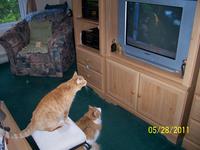
Well isn't Mollie a funny and very intelligent girl! There is a misconception (or misunderstanding) about dry food. My friends and I in rescue pass this around to anyone who adopts or has cats because many vets, for some reason, don't seem to be educating their customers as they should - maybe for fear of losing money...: (Besides the fact that dry food contributes greatly to obesity, renal failure, diabetes, etc. and cats usually don't drink enough unless as a result of already having organ problems).
From Cat Health Website:
Food and Nutrition
Wet and Dry Food
In this and future articles, we're fortunate to have expert input from veterinarian Dr. Marcus Brown, co-founder of the Capital Cat Clinic in Arlington, Virginia, and scientific advisor to Alley Cat Allies, about cats and their food.
The Importance of Wet Food
A mouse—wild cats' favorite prey—is analogous to today's "wet food." The portion of the animal that kitty's ancestors ate is 75 or 80 percent water, the same as what's in a can of modern cat food. Dr. Brown points out that it is through their food that cats in the wild get most of their moisture; cats are not naturally voracious drinkers. On a mostly dry food diet, a cat's thirst mechanism, the signal from her brain that says "you're thirsty, you need to drink," may not compel her to take in enough water to compensate for the
lack of moisture in her diet. Among other risks, if kitty's body has insufficient water -— and since water dilutes and flushes out substances — solids such as crystals may more readily concentrate and turn into stones that produce pain or interfere with kitty's urinary system; if the stones are big enough
they can prevent kitty from eliminating toxins, which is a life-threatening situation.
Therefore Dr. Brown recommends daily wet food for cats. If for some reason your cat refuses to eat wet food, and you've tried different brands and varieties, consider buying a kitty water fountain. The moving water typically incentivizes cats to drink out of them. Perhaps this is because in nature, moving water is clean water; perhaps cats are just fascinated by the movement and the "there, yet not there" aspect of the water; perhaps the running water tastes fresher.
Teeth
"But don't cats need to chew on dry food to clean their teeth?" you might be thinking. The idea is that as kitty chews, the abrasive action of the food scrapes away deposited matter that could lead to inflammation and erosion of the teeth and gums. But according to Dr. Brown, with the exception of specially formulated dental diets, studies have not shown any difference in dental health between cats on predominantly dry food diets and cats on predominantly wet food diets. For one thing, cats barely chew. When kitty grabs a piece of kibble with his teeth, he crunches maybe once or twice, then it's down the hatch. Humans' saliva contains an enzyme that breaks down food as we chew it, so our digestive process starts in the mouth. However, cats' saliva does not have this sort of enzyme, so they get far less benefit from chewing; from their digestive system's point of view, it makes sense to get that food out of the mouth and into the esophagus, so the cats' body can start the process of extracting nutrients from it.
Carbs
Dr. Brown also notes that hard cat food tends to be higher in carbohydrates, which can be a bad thing for cats' dental health as well as general health. Compared to humans, cats have a low threshold for carbohydrates. Humans have enzymes that help them effectively handle diets with a high percentage of complex carbohydrates — the American Heart Association recommends that humans get 50-55 percent of their calories from carbohydrates (the "good" carbs, like fruits, vegetables, and whole grains), and in some healthy people's diets, that figure is as high as 80 percent. But carbohydrates in those amounts would overwhelm a cat. The primary source of carbohydrates for cats throughout their evolution has been the
small amount of digested vegetable matter in the stomachs of their prey. Small carbohydrate-rich crumbs may break off from pieces of kibble, lodge between the teeth, and break down into starch and acid, thereby
accelerating tooth and gum deterioration in cats.
 Please have your pets sterilized as soon as possible to lower, and one day hopefully eliminate, unwanted and abandoned pets. It IS our responsibility. Adopting from a shelter also helps - encouraging breeders just adds to the overpopulation.
 Reply With Quote
Bookmarks