


Will keep good thoughts and prayers that it's not FIP


 Registered User
Will keep good thoughts and prayers that it's not FIP
Owned by my 8 precious furry kids... My 3 daughters Cindy & Abby & Aly and 5 sons Skinny, Stephen, Carson, Fuzzmuzz and Franklin.
Owned by two special canine sons Coco and Snoopy and two canine daughters, Sadie and Gretchen
Always in our hearts RBButterscotch & RBThumper, RB Ms. Eleanor
 Registered User
I don't get here very much, so I'm just now learning about Mr. Meow - and can't begin to say how glad I am that it's not cancer - and how sad I am that it might be FIP.
Back in October, I had the vet use those words to me when I took My Sweet Lady in for labored breathing. When the vet mentioned FIP, I nearly threw up onto the exam table. However, somewhere, somehow, I learned that FIP is not contagious - I have three other felines in the house! Even at that, I was most relieved to learn that Lady doesn't have FIP, and I pray that Mr. Meow doesn't either.
Although Lady's problem, like Mr. Meow's, is with her lymphatic system, it isn't from an infection - which surely is more easily treated than what she does have: idiopathic chylothorax. Her only symptom has been labored breathing - none of the diarrhea you mention.
Oh, Jen, I hope for a happy outcome for you & Mr. Meow! I"ll try to get here more often to watch his progress.
Lady-in-Waiting to HRH The PrinCESS Althea
 Feral Cat Rescuer
Good luck with this! Hopefully all will work out!
Trap-Neuter-Return (TNR) is a full management plan in which stray and feral cats already living outdoors in cities, towns, and rural areas are humanely trapped, then evaluated, vaccinated, and sterilized by veterinarians. Kittens and tame cats are adopted into good homes. Healthy adult cats too wild to be adopted are returned to their familiar habitat under the lifelong care of volunteers
 Friend To All Starry Cats
THE FOUND CATS AND I ARE PRAYING TOO THAT MR MEOW WILL BE ALL RIGHT , AND THATS ITS NOT FIP.
I KNOW THAT THE PET ANGELS, LED BY Y.LEE WILL BE THERE TO COMFORT MR MEOW AND MAKE HIM FEEL GOOD.

THE GOOD NEWS IS THAT MR MEOW IS IN THE BEST PLACE THAT HE CAN BE IN WITH ONE OF THE MOST CARING MEOWMIES ON PET TALK.
THE RAINBOW BRIDGE FOUND HOTEL ANGELS HAVE A NEW FRIEND IN CORINNA.
ALMOND ROCCA BATON AND ELLIE ANGELS ARE GUARDIANS TO ETERNAL KITTENS ROCC-EL AND T TEEN ANGEL, ALMOND ROCA , VLAD , PAWLEE , SPRITE. LITTLE HEX, OSIRIS AND ANNIE ANGELS.
EBONY BEAU TUBSTER AND PEACHES BW SPIKE & SMOKEY
NOW PRECIOUS AND SAM ARE TOGETHER WITH ETERNAL KITTENS SAMMY ,PRESLEY, SYLVESTER AND SCRATCHY JR , MIGHTY MARINA, COSMIC CARMEN, SAMSON ,UNDER KITTY AND SUNKIST AUTUMN & PUMPKIN.
MIA AND ORANGE BLOSSOM ANGELS HAVE ADOPTED TUXIE , TROOPER , SONGBIRD AND LITTLE BITTY KITTIES MIA-MI BLOSSOMER, TUXEDO AND DASH AS THIER ETERNAL KITTENS.
PRINCESS JOSEPH AND MICHAEL ARE CELEBRATING 19 YEARS AS LUCKY FOUND CATS
 Pats and cats

Glad that Mr. Meow does not have cancer, but prayers that he does not have FIP.
Whatever is going on with him, he could not be in a better home, and he will always have the most love and very best care possible.
Love to both of you, Jen and Mr. Meow.
Pat and cats
 Vet Assistant 16 years
I'm not sure by the information that it's not contagious. FIP is caused by a corona virus (not quite like the dog version). Many cats carry the corona virus but do not have FIP. Cats can spread the corona virus by saliva, feces, and direct contact. When the virus mutates it then becomes FIP. It's kinda complicated and an idividual response to the virus so not all cats exposed to the corona virus will get FIP.Originally Posted by maerlyn
From the Cornell Feline Heath Center
Infected cats shed coronavirus in their saliva and feces. Most cats become infected by inhaling or ingesting the virus, either by direct contact with an infected cat, or by contact with virus-contaminated surfaces like clothing, bedding, feeding bowls, or toys.
Although the virus can survive for a number of weeks in the environment, it is rapidly inactivated by most household detergents and disinfectants. An inexpensive and effective disinfectant is one part of household bleach in thirty-two parts of water (4 ounces of bleach per gallon of water).
Most cats that undergo the primary infection completely recover, although some of them may become virus carriers. Only a small percentage of exposed cats develop the lethal disease: weeks, months, or perhaps years after primary infection.
Young cats (less than two years of age), older cats (over ten years old), cats in poor physical condition, and cats undergoing concurrent infections or stress are more susceptible to FIP. It is a relatively uncommon disease in the general cat population, probably affecting fewer than one percent of the cats brought to a veterinarian's office for treatment. In multiple-cat populations such as some shelters and catteries the disease rate can be much higher, affecting up to 10 to 20 percent of the susceptible population over a period of several months.
Can I protect my cat from getting FIP?
In multiple cat environments, keeping cats as healthy as possible and minimizing exposure to infectious agents lessens the likelihood of cats' developing FIP. Preventing overcrowding, keeping cats current on vaccinations, providing proper nutrition and adequate sanitation, and eliminating feline leukemia virus infections can be helpful in reducing the incidence of FIP groups of cats.
Once clinical signs appear, cats with the effusive (wet) form of FIP will live a few days to a few weeks, although some adult cats may linger for six to eight months. Cats with the dry form of FIP usually die within a few weeks, but survival for up to a year or more is possible.
Providing good nursing care and feeding a balanced, highly nutritious diet will make your cat more comfortable in the terminal stages of the disease. Your veterinarian may prescribe medications to reduce the discomfort associated with the disease or provide more-specific supportive therapy.
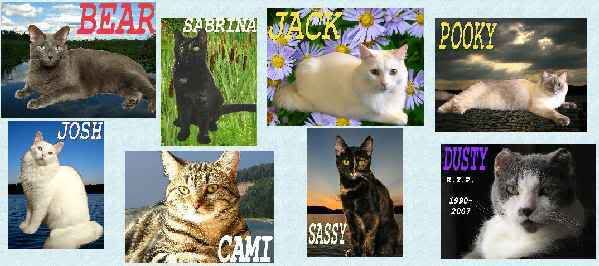
RIP Dusty July 2 2007RIP Sabrina June 16 2011
Registered User
Jen, I wish I knew what to say to make all of this go away. I don't recall how old Mr. Meow is but I hope this might help just a little bit. When it came time to have Groucho neutered our vet did the standard pre-op tests. He tested positive for FIP but our vet said that since he was under 6 months old he could be testing positive for his mother's antibodies. Doctor scheduled a second test a few weeks later, the count was better but not where she wanted to see it. A third test was done and Groucho tested negative. This might be something to discuss with your vet.
Many prayers continue to be prayed for Mr. Meow and for you.....
FIND A PURPOSE IN LIFE.....BE A BAD EXAMPLE
 The Cat Groomer
This sounds much more like FIV than FIP. (very easy to confuse)
Also, keep in mnd there are 2 forms of FIP (effusive and non-effusive) aka wet vs. dry forms. The wet form is much worse.
But, Mr Meow has been here for almost 7 months...... His only initial symptom was that he would not eat. He hasn't had diarrhea until recently (and I am not sure whether he still does today or not)
What I can tell you is that for the past 2 days or so he has eaten VERY well!
So....we wait for the results of the "stains".
.
 It's what plants crave...
It is kind of tricky to understand. Up to 80% of cats coming from shelter or breeder environments will titre high for coronavirus. Then in only a small percentage will it mutate into FIP.
Oddly enough, of approximately 50 fosters I have had, 2 have developed FIP in their forever homes.
That is much higher than the FIP statistics read. I've had about a 4% occurrence. I hope I never encounter or hear of it again.
(my personal cats were exposed, I assume, but never developed FIP, even my immune comprimised old man Malfi)
Testing directly for FIP is unreliable. It only tells you of exposure to coronaviruses, which like I said, most of my cats would titre high for.
My gut says Mr. Meow doesn't have FIP. FIP doesn't really have anything to do with the golf ball sized lump that he's got, does it?
All the best to Mr. Meow & Jen
 5 Cats 4 Bichons Frisé
I can't say any better than this. Prayers from RI for Mr. Meow, and hugs to you, Jen. He is definitely in a good place for TLC!
.
 Seven is Heaven!!
Jenn, any results yet????
Nine is Fine!!
The Cat Groomer
not yet. hopefully SOON!
Good news: no more diarrhea and a WONDERFUL appetite!
.
 Registered User
Poor baby. My prayers are with him. He couldn't be in any better hands than yours!
Special Needs Pets just leave bigger imprints ♥ on your heart!
 Registered User

YAAAY! Mr Meow - you go! Asymptomatic is good, no matter what the tests show! Mr Meow didn't read the reports, so he is doing fine!
Jen, give that guy a snuggle for me!
"Do or do not. There is no try." -- Yoda
The Cat Groomer
I hate waiting for results!!!! GGGRRRR.
But here is a piece of news to celebrate about.
Mr. Meow, after living here for 6 months, being force fed, eating Meow Mix market select EXCLUSIVELY, sticking his nose in the air over MULTIPLE choices of food............was caught eating DRY cat food!Unbelievable!
.
 Posting Permissions
Copyright © 2001-2013 Pet of the Day.com


 Reply With Quote



Bookmarks